Ceiling Cassette Mini Split in Cape Coral, FL
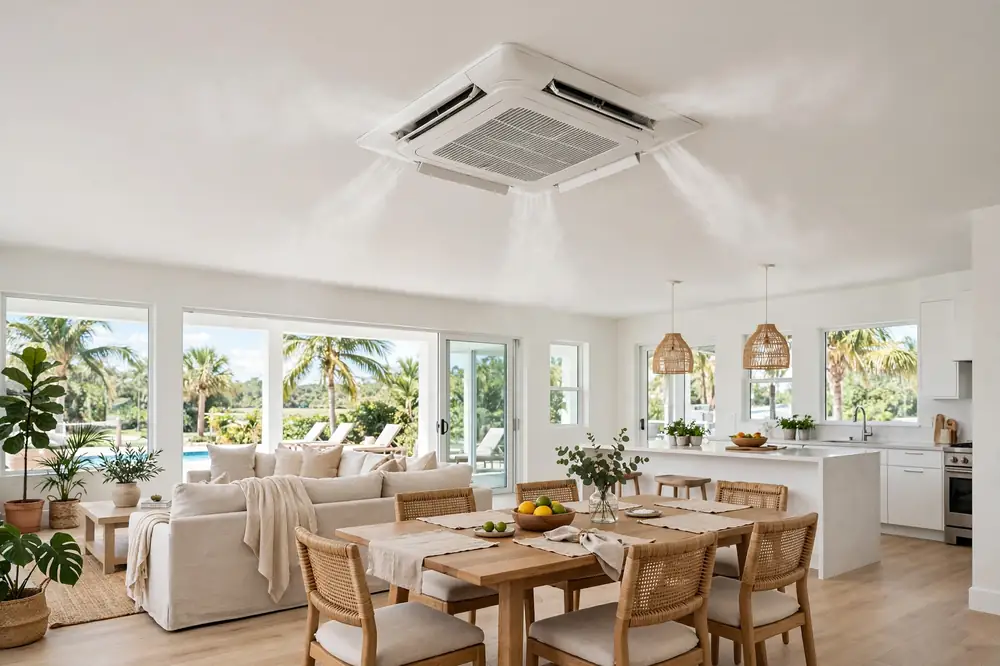
A ceiling cassette mini split sits in the ceiling and throws air in four directions. It fits a large room or an open-plan space in Cape Coral, FL where a wall unit cannot cover the room.
Need help with mini split?
Call Now to reach a local mini split professional. Describe the room, the system, and what is happening.
Hours: Mon–Fri 7:00 AM–10:00 PM ET · Sat 8:00 AM–10:00 PM ET · Sun 7:00 AM–9:00 PM ET
What this service does
A ceiling cassette is a ductless indoor unit that sits in the ceiling, with only a flat grille visible below the ceiling line. It throws air in four directions — out of each side of the grille — so it covers a large room or an open-plan space evenly, where a wall unit throws air in one direction and leaves the far corners warm. It is the indoor unit for the rooms a wall unit cannot cover: a large living room, an open-plan kitchen and living area, a lanai with glass on three sides and no wall space, a commercial space with a drop ceiling.
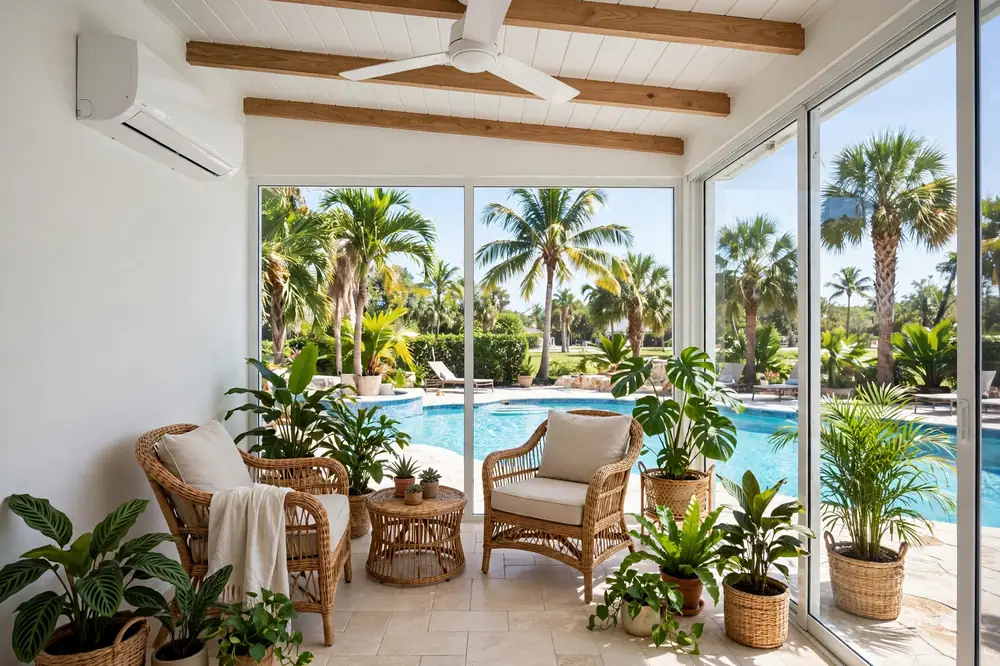
Cape Coral, FL has more cassette candidates than most cities, because of the housing. Many homes here have large open-plan living areas, lanais with glass on three sides, and converted spaces with high ceilings and little wall space. A wall unit in a large open-plan room throws air across the room and leaves the far side warm; a cassette in the middle of the ceiling throws air in four directions and covers the room evenly. A lanai with glass on three sides has no wall for a wall unit, and a cassette is the answer that does not block the glass.
The install is different from a wall unit in one important way: the ceiling. A cassette needs a ceiling with space above it — a drop ceiling, a suspended ceiling, or a ceiling with enough clearance for the unit body. The unit sits above the ceiling line, the grille sits flush below it, and the line set and drain run above the ceiling to the outdoor unit. The ceiling is checked before the work starts: its structure, its clearance, and whether the drain can fall away from the unit. A ceiling that cannot take a cassette is the reason the assessment happens first.
The permits are the same — mechanical and electrical — and the load check is the same: the room is measured, the windows and sun are counted, and the unit is sized to the room. A cassette is not a bigger unit; it is a different indoor unit for a different room. The handover explains the remote, the modes and the filter, and the inspection closes the permits after.
Before you call
- Note which room the unit serves and what it is doing — or not doing.
- Check the remote: mode, temperature setting, and whether the display responds.
- Look at the indoor filter and the outdoor unit for leaves, dirt or standing water.
- Note when the problem started and whether it followed a storm or a power outage.
- Check whether your HOA or condo association needs to approve outdoor equipment.
How a ceiling cassette mini split works in a Cape Coral, FL home
A cassette sits in the ceiling, with only a flat grille visible below the ceiling line. The unit body is above the ceiling, the grille is flush with it, and the air comes out of each side of the grille in four directions. That four-way throw is the point: a large room or an open-plan space gets even coverage, where a wall unit throws air in one direction and leaves the far corners warm. The grille is the only part visible in the room, and it is the part that is cleaned.
The ceiling is checked before the work starts. A cassette needs a ceiling with space above it — a drop ceiling, a suspended ceiling, or a ceiling with enough clearance for the unit body. The structure is checked: whether the ceiling can carry the unit, whether there is clearance for the line set and the drain, and whether the drain can fall away from the unit to the outside. A ceiling that cannot take a cassette is the reason the assessment happens first, and the answer in that case is a wall unit or a floor-mounted unit instead.
The line set and the drain run above the ceiling from the cassette to the outdoor unit. The copper lines are insulated, the drain line runs downhill so condensate flows away from the house, and a drain pump is fitted where the fall is not enough — a cassette drain often needs a pump, because the unit sits in the ceiling and the drain has to lift before it can fall. The pump is tested during the install, and it is checked on every maintenance visit, because a failed pump is a cassette that leaks into the ceiling.
The outdoor unit sits on a pad, a wall bracket or an elevated platform, anchored to a wind-rated mount with corrosion-resistant hardware, and elevated above expected flood levels. The electrical work is a dedicated 208/230V circuit, with a disconnect box near the unit, covered by a separate electrical permit under NEC Article 440. Testing runs the system through Cool, Heat and Dry modes while airflow, temperature change and the drain are checked — and the drain pump is tested, because a cassette that cannot drain is a cassette that leaks.


What the service includes
Room assessment and load check
The room is measured and the load is checked, so the cassette is sized to the room.
Ceiling check
The ceiling is checked for structure, clearance and drain fall before the work starts.
Cassette mounting
The cassette is set into the ceiling, with only the flat grille visible below the ceiling line.
Line set and drain run above the ceiling
Copper refrigerant lines, drain line and control cable run above the ceiling to the outdoor unit.
Drain pump where the fall needs it
A drain pump is fitted where the fall is not enough, and tested during the install.
Outdoor unit placement and anchoring
The outdoor unit is set on a pad, bracket or elevated platform, anchored to a wind-rated mount with corrosion-resistant hardware.
Electrical circuit and disconnect
A dedicated 208/230V circuit and a disconnect box near the unit, covered by a separate electrical permit.
Pressure test, vacuum and charge
The line set is pressure-tested, vacuumed and charged with refrigerant before the system runs.
Testing in every mode, including the drain pump
The system is run through Cool, Heat and Dry modes, and the drain pump is tested.
How the work runs
Call and describe the room
How big it is, what ceiling it has, how much glass it has, and why a wall unit does not fit it.
Assessment and ceiling check
The room is measured and the load is checked, and the ceiling is checked for structure, clearance and drain fall.
Permits
Mechanical and electrical permits are pulled before work starts.
Installation
The cassette is set into the ceiling, the line set and drain run above the ceiling, and the outdoor unit is set, anchored and connected.
Testing
The system is pressure-tested, vacuumed, charged, and run through cooling, heating and Dry modes, and the drain pump is tested.
Handover
The remote, the modes and the filter are explained, and the inspection is arranged.

Tools and methods used
Load calculation
A load check that turns room size, windows, sun and insulation into the right cassette size.
Torque wrenches and flaring tools
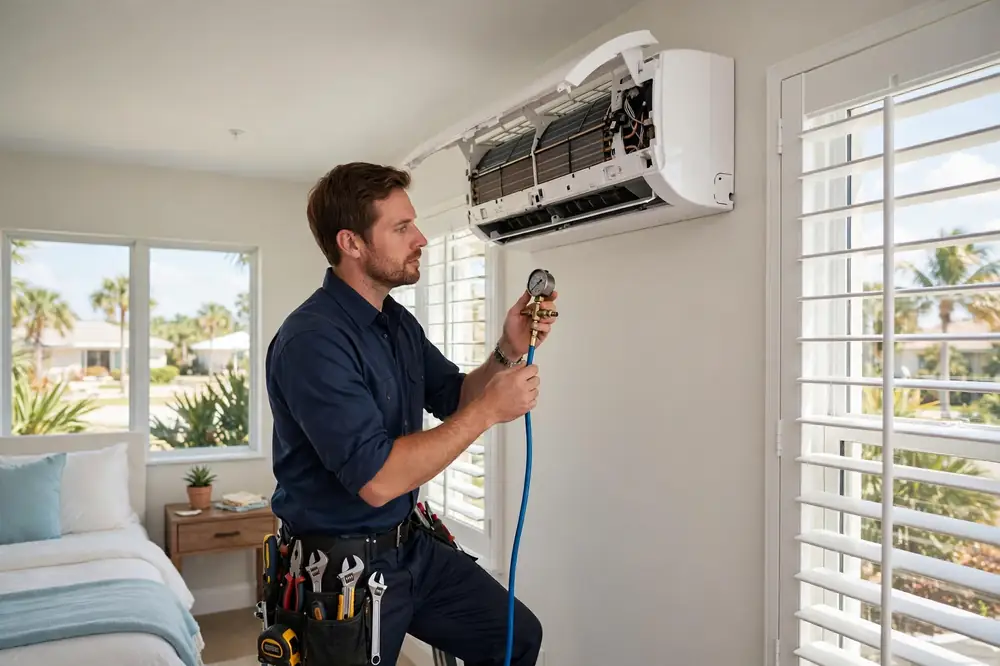
Flaring tools shape the copper line ends, and torque wrenches tighten the flare nuts to the right tension — too loose leaks, too tight cracks.
Nitrogen pressure test
The line set is filled with nitrogen and held at pressure, so a leak shows up before refrigerant goes in.
Vacuum pump and micron gauge
A vacuum pump pulls air and moisture out of the line set, and a micron gauge confirms the vacuum holds.
Refrigerant gauges
Gauges read the system pressures while the unit runs, confirming the charge is right.
Level and core drill
A level keeps the cassette straight so the drain flows, and a core drill makes the small, clean wall opening for the line set.
Four-way throw: why a cassette covers a large room
A wall unit throws air in one direction. In a small room that is enough, because the air reaches the far wall and comes back. In a large room or an open-plan space it is not enough: the air reaches partway across the room, and the far corners stay warm. A ceiling cassette throws air in four directions from the middle of the ceiling, so each side of the room gets its own airflow, and the room is covered evenly.
The four-way throw is the reason a cassette fits the rooms a wall unit cannot cover: a large living room, an open-plan kitchen and living area, a lanai with glass on three sides, a commercial space with a drop ceiling. The cassette is not a bigger unit — it is a different indoor unit for a different room, and the load check sizes it the same way: the room is measured, the windows and sun are counted, and the unit is chosen to the room.
The ceiling, the drain and the pump
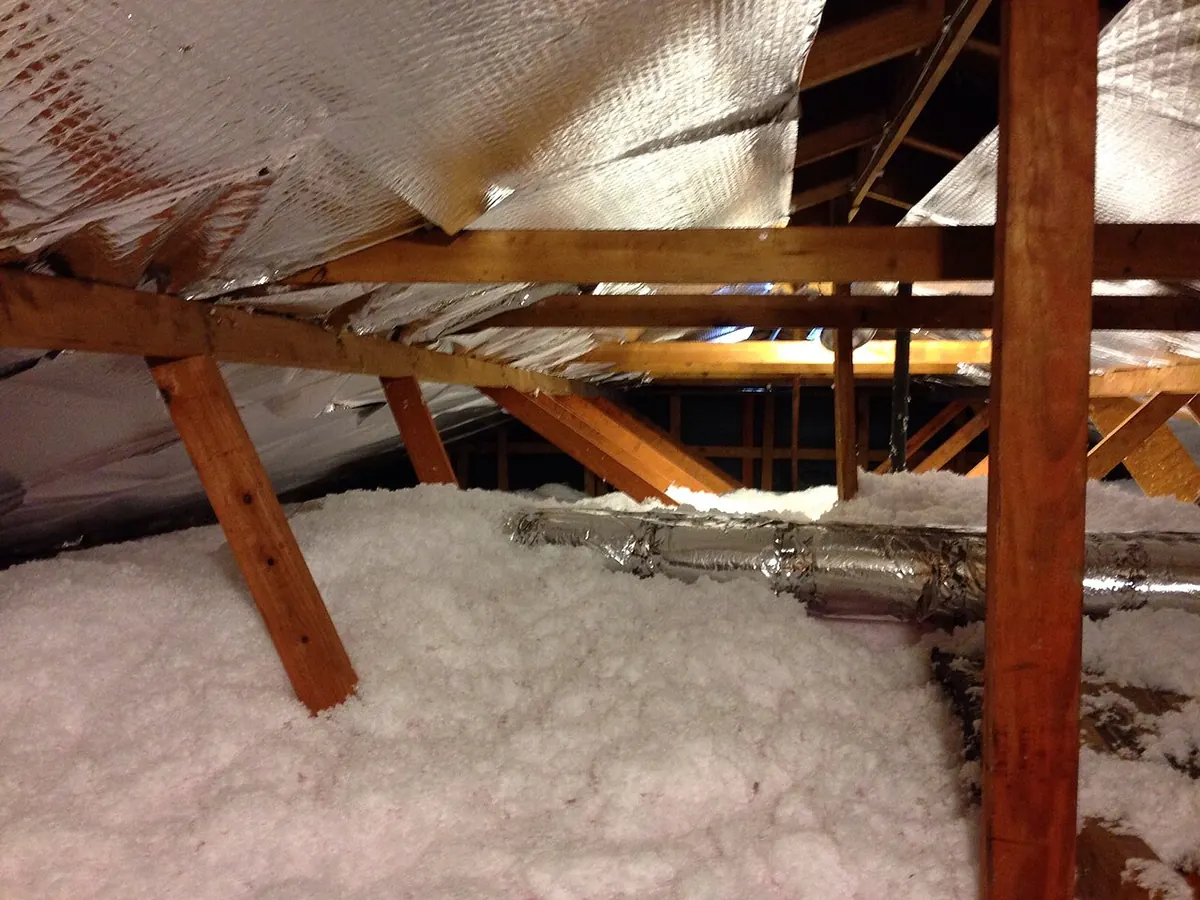
A cassette lives in the ceiling, and the ceiling decides whether it can. The ceiling needs space above it for the unit body, structure that can carry the unit, and a drain route that falls away from the unit to the outside. A cassette drain often needs a pump, because the unit sits in the ceiling and the drain has to lift before it can fall — and a failed pump is a cassette that leaks into the ceiling, which is why the pump is tested during the install and checked on every maintenance visit.
The ceiling check is the assessment, and it happens before the work starts. A ceiling that cannot take a cassette is not a failed job — it is a job where the answer is a wall unit or a floor-mounted unit instead. The assessment is the moment that decision is made, not the install day.
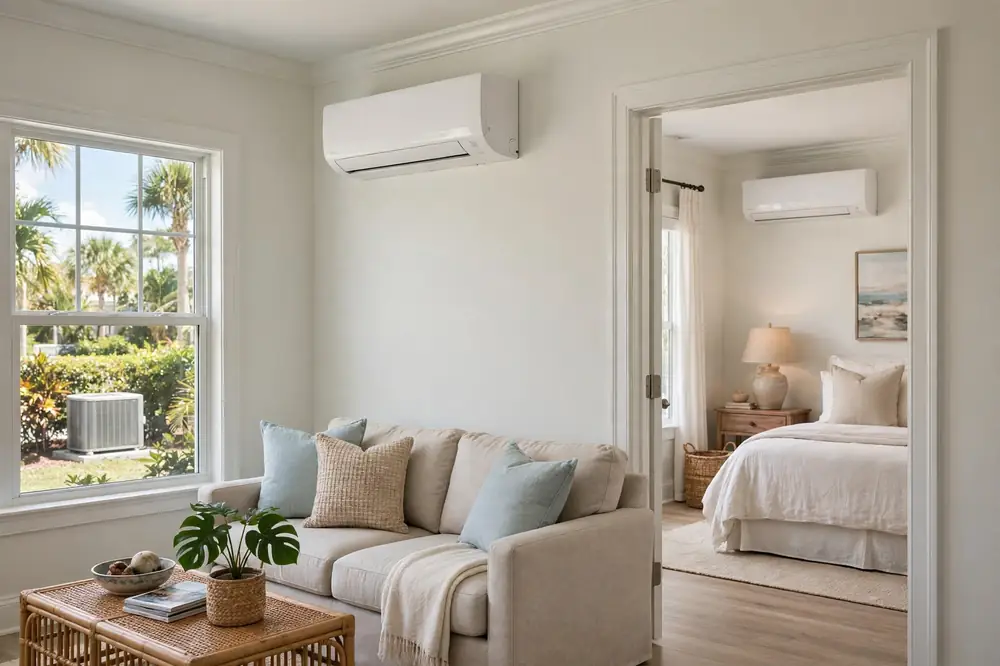
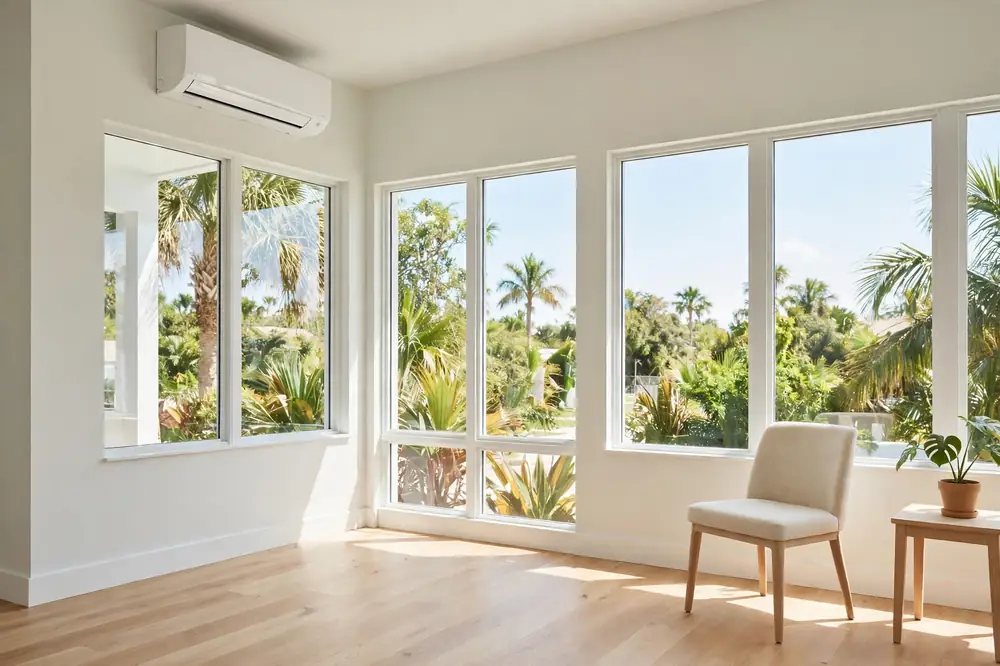
A large open-plan living room in Cape Coral with a wall unit that throws air in one direction and leaves the far side warm.
A room that stays warm, damp or noisy does not fix itself — and the cause is usually small: a dirty filter, a clogged drain, or a unit sized wrong for the room.
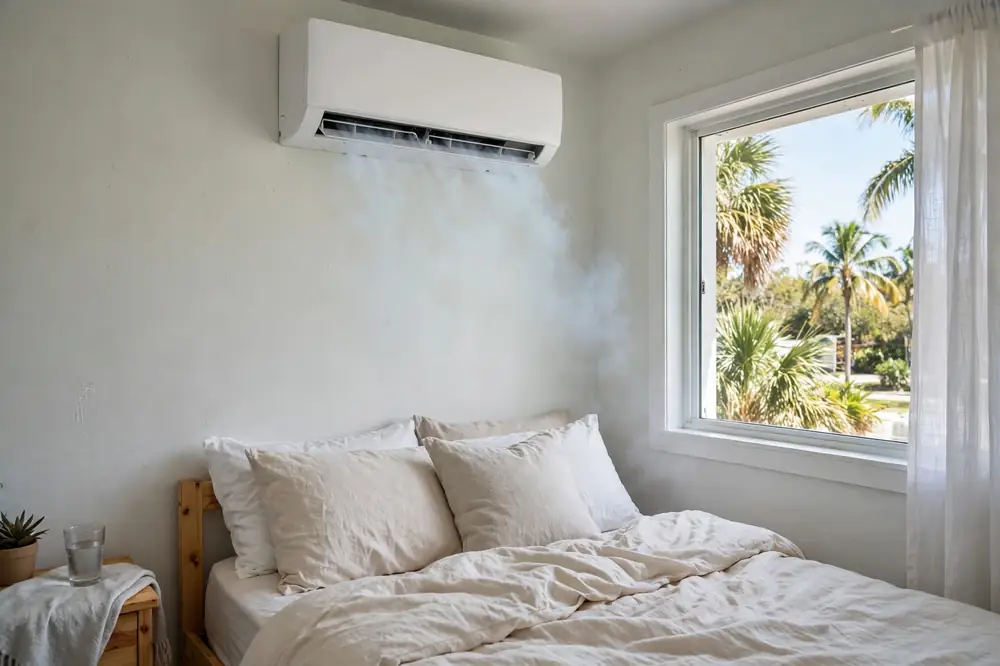
A ceiling cassette set into the ceiling, throwing air in four directions, with only a flat grille visible below the ceiling line.
The work is checked in the room, at the thermostat and at the outdoor unit — not guessed from the driveway.
Guides and posts that go with ceiling cassette mini split
Signs a ceiling cassette mini split fits your room
- A large room or open-plan space where a wall unit leaves the far corners warm.
- A lanai with glass on three sides and no wall space for a wall unit.
- A commercial space with a drop ceiling and a large floor area.
- A room with a high ceiling where a wall unit would throw air too low.
- A living room where a wall unit would block the view or the light.
- An open-plan kitchen and living area that needs even coverage in four directions.
- A room where the only visible part should be a flat grille, not a unit on the wall.
- A space with a suspended ceiling that already has room above it for the unit body.
Related guides
Mini split sizing guide · How a mini split works · Mini split lanai cooling
Industries that use this service
Commercial · Hospitality & Restaurants · Residential · All industries →
Frequently asked questions
Questions people ask about ceiling cassette mini split, answered plainly.
When the room is large or open-plan, and a wall unit throws air in one direction and leaves the far corners warm. A cassette throws air in four directions from the middle of the ceiling, so it covers a large room evenly. It is also the answer where there is no wall space — a lanai with glass on three sides, or a room where a wall unit would block the view.
It needs space above it for the unit body — a drop ceiling, a suspended ceiling, or a ceiling with enough clearance. The ceiling is checked before the work starts: its structure, its clearance, and whether the drain can fall away from the unit. A ceiling that cannot take a cassette is the reason the assessment happens first.
Not when the drain is right. The drain line runs downhill from the cassette, and a drain pump is fitted where the fall is not enough — a cassette drain often needs a pump, because the unit sits in the ceiling and the drain has to lift before it can fall. The pump is tested during the install and checked on every maintenance visit.
The same way as any ductless unit: the room is measured and the load is checked — size, ceiling height, windows and sun, insulation and use. A cassette is not a bigger unit; it is a different indoor unit for a different room. The sizing guide on this site explains the load check in full.
Yes, if it is a heat pump — and most ductless systems in Cape Coral, FL are. The room is heated by the same unit that cools it, with its own remote and its own temperature. The winter-heating post on this site explains the Florida winter picture.
Yes. A mechanical permit and usually a separate electrical permit for the new dedicated circuit and disconnect, pulled before work starts. The permit guide on this site explains the full picture.
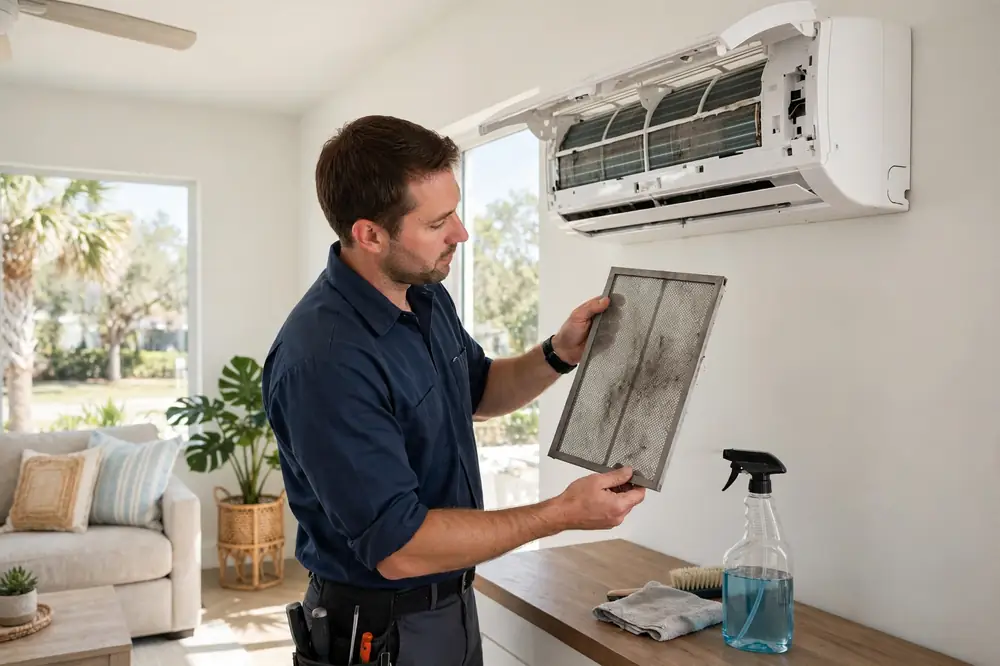
The grille opens and the filter slides out from behind it, rinses under a tap, dries completely, and slides back in. The handover after an install or a maintenance visit shows how it comes out on your unit. The filter is the owner job between visits, and a cassette filter needs cleaning just as often as a wall-unit filter.
Mini split trouble in your Cape Coral home?
Call Now to reach a local mini split professional. Describe the room, the system, and what is happening.
Call now for mini split help
Tap Call Now to reach a local mini split professional. Tell them which room, what the unit is doing, and when it started.
Hours: Mon–Fri 7:00 AM–10:00 PM ET · Sat 8:00 AM–10:00 PM ET · Sun 7:00 AM–9:00 PM ET
Before you call
- Note which room the unit serves and what it is doing — or not doing.
- Check the remote: mode, temperature setting, and whether the display responds.
- Look at the indoor filter and the outdoor unit for leaves, dirt or standing water.
- Note when the problem started and whether it followed a storm or a power outage.
- Check whether your HOA or condo association needs to approve outdoor equipment.