Mini Split Maintenance in Cape Coral, FL
A mini split in Cape Coral, FL runs most of the year in salt air and high humidity. Maintenance is the filter, the coils, the drain and the outdoor unit — checked and cleaned before the fault, not after.
Need help with mini split?
Call Now to reach a local mini split professional. Describe the room, the system, and what is happening.
Hours: Mon–Fri 7:00 AM–10:00 PM ET · Sat 8:00 AM–10:00 PM ET · Sun 7:00 AM–9:00 PM ET
What this service does
A ductless mini split has no ductwork to hide a problem in, which is both its strength and its demand: everything that goes wrong shows up in the room, and everything that keeps it running is visible and reachable. The filter is behind the front panel of the indoor unit. The coil is behind the filter. The drain is under the coil. The outdoor coil is on the back of the outdoor unit. Maintenance is the work of keeping those four things clean and clear, and of catching the fifth thing — the slow change — before it becomes a repair.
In Cape Coral, FL the maintenance list is longer than it would be inland, because the climate adds two jobs. Salt air works on the outdoor coil and cabinet, so the outdoor unit is inspected for corrosion and rinsed as part of the visit. Humidity works on the drain, so the drain line is flushed and the fall is checked, because a clogged drain is the most common cause of water on the floor from a mini split in a Florida home. A maintenance visit that skips the outdoor coil and the drain has skipped the two things that fail first here.
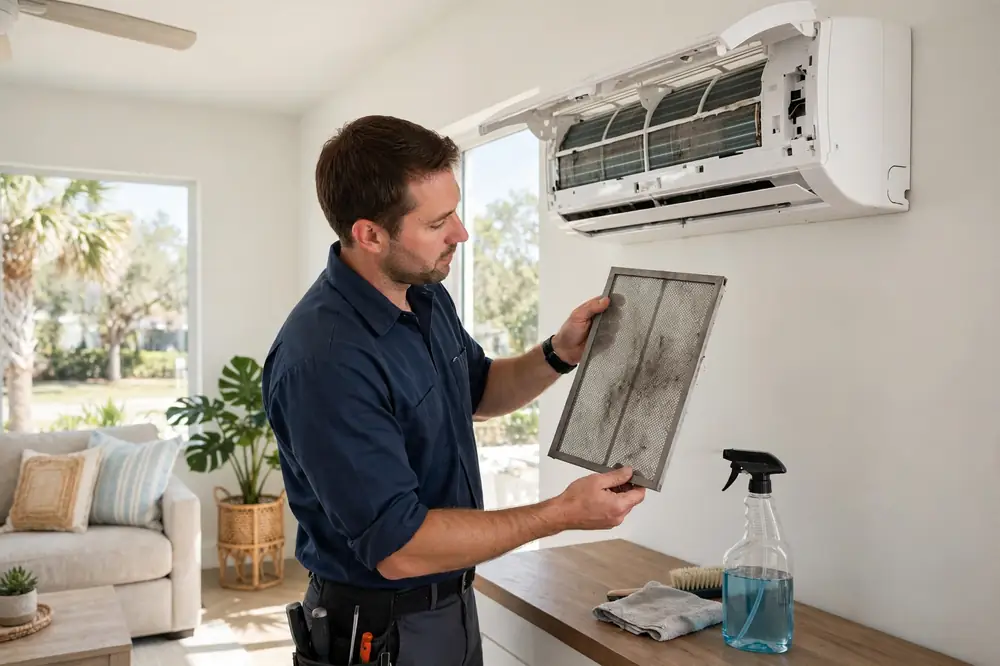
The filter is the owner job, and it is the one that matters most between visits. A filter that has not been cleaned in months chokes the airflow, and low airflow is the fault that looks like everything else: weak cooling, icing on the coil, a unit that short-cycles. The filter comes out from behind the front panel, rinses under a tap, dries, and goes back in. The handover after an install or a maintenance visit shows how it comes out and how often it needs cleaning — in a Florida home with pets or dust, more often than the manual suggests.
The visit itself follows a fixed list, and the list is the same every time: filter, indoor coil, drain, outdoor coil and cabinet, fan, refrigerant pressures, electrical connections, and the remote and the modes. The visit is also the moment a slow change is caught — a coil starting to corrode, a drain starting to slow, a fan starting to wear, a pressure reading that has drifted since the last visit. A maintenance visit that finds nothing wrong is not a wasted visit: it is the visit that kept the next repair from happening.
Before you call
- Note which room the unit serves and what it is doing — or not doing.
- Check the remote: mode, temperature setting, and whether the display responds.
- Look at the indoor filter and the outdoor unit for leaves, dirt or standing water.
- Note when the problem started and whether it followed a storm or a power outage.
- Check whether your HOA or condo association needs to approve outdoor equipment.
What a mini split maintenance visit covers in Cape Coral, FL
The filter comes first, and it is the owner job as well as the visit job. The filter is removed from behind the front panel of the indoor unit, rinsed, dried and put back. A filter that has not been cleaned in months chokes the airflow, and low airflow is the fault that looks like everything else: weak cooling, icing on the coil, short-cycling. The visit shows how the filter comes out and how often it needs cleaning, because a Florida home with pets, dust or a lanai door that stays open needs it more often than the manual suggests.
The indoor coil is inspected and cleaned. The coil sits behind the filter, and it collects the dust and growth that the filter lets through, especially in a humid home. A coated coil does not transfer heat well, so the cooling weakens and the unit runs longer. The coil is cleaned with a coil cleaner that does not bend the fins, and the fin comb straightens any fins that have been bent. The drain pan under the coil is checked for level and for cracks, because a unit that is not level does not drain.
The drain line is flushed and the fall is checked. Algae and biofilm grow in the warm, dark, wet line and clog it, so condensate backs up into the indoor unit — the most common cause of water on the floor from a mini split in a Florida home. The line is flushed clear, the fall is checked so water runs downhill away from the house, and a drain pump, where one is fitted, is tested. A drain that is clear and falling is a drain that does not leak.
The outdoor unit is inspected for salt-air corrosion and rinsed. The coil is checked for white crust on the fins, for fins that crumble when touched, and for refrigerant stains at the coil — the early signs of a coil failing in salt air. The cabinet and fasteners are checked for corrosion, the fan is checked for wear, and the coil is rinsed to wash salt off the fins. The anchoring is checked too, because a unit that has shifted in wind is a unit that will leak refrigerant.
The refrigerant pressures, the electrical connections and the controls are checked last. Pressures and temperatures are read while the unit runs and compared with the last visit, because a pressure reading that has drifted since the last visit is the early sign of a slow leak. Electrical connections are checked for tightness and for heat damage. The remote is checked — batteries, mode, and whether Dry mode works — because a remote that has lost a mode is a unit that cannot dehumidify.

What the service includes
Filter clean and owner walk-through
The filter is cleaned and the owner is shown how it comes out and how often it needs cleaning.
Indoor coil inspection and clean
The indoor coil is inspected and cleaned without bending the fins, and the drain pan is checked for level and cracks.
Drain flush and fall check
The drain line is flushed clear of algae and biofilm, the fall is checked, and a drain pump is tested where one is fitted.
Outdoor coil inspection and rinse
The outdoor coil is checked for salt-air corrosion and rinsed to wash salt off the fins.
Outdoor cabinet, fan and anchoring check
The cabinet and fasteners are checked for corrosion, the fan for wear, and the anchoring for wind damage.
Refrigerant pressure check
Pressures and temperatures are read while the unit runs and compared with the last visit, to catch a slow leak early.
Electrical connection check
Connections are checked for tightness and for heat damage, and the disconnect is checked.
Remote and modes check
The remote, the batteries and the modes — Cool, Heat and Dry — are checked, because a lost mode is a lost function.
How the work runs
Call and book the visit
How many indoor units, how old the system is, and when it was last serviced.
Filter and indoor coil
The filter is cleaned and the indoor coil is inspected and cleaned.
Drain
The drain line is flushed, the fall is checked, and the pan is checked.
Outdoor unit
The outdoor coil is inspected for corrosion and rinsed, and the cabinet, fan and anchoring are checked.
Pressures and electrical
Refrigerant pressures and electrical connections are checked and compared with the last visit.
Handover
What was found, what was cleaned, what to watch for, and when the next visit should be.




Tools and methods used
Coil cleaner and fin comb
Cleans the indoor and outdoor coils without bending the fins, and straightens fins that have been bent.
Drain flush kit
Flushes the drain line clear of algae and biofilm, the growth that clogs Florida drain lines.
Refrigerant gauges
Read the system pressures while the unit runs, and show whether the charge has drifted since the last visit.
Multimeter
Reads voltage, current and resistance, so a wearing capacitor or a loose connection is found by measurement.
Level
Checks the indoor unit is level, so the drain pan drains instead of holding water.
Hose and rinse nozzle
Rinses salt off the outdoor coil and cabinet, and washes the outdoor coil fins clean.

The filter: the owner job that decides everything
The filter is the one maintenance job the owner does, and it is the one that matters most between visits. A filter that has not been cleaned in months chokes the airflow, and low airflow is the fault that looks like everything else: weak cooling, icing on the coil, a unit that short-cycles and leaves the room clammy. The filter comes out from behind the front panel, rinses under a tap, dries, and goes back in — and the handover after an install or a maintenance visit shows how it comes out on your unit.
In a Florida home the filter needs cleaning more often than the manual suggests. Pets, dust, a lanai door that stays open, and a unit that runs most of the year all load the filter faster. A filter that is cleaned every few weeks keeps the coil clean, the drain clear and the unit running the way it did when it was new. A filter that is never cleaned is the reason the coil is coated, the drain is slow and the unit is icing up.
Salt air and the maintenance calendar in Cape Coral, FL
Cape Coral, FL is a canal city on the Gulf, and the maintenance calendar follows the climate. Salt air works on the outdoor coil and cabinet all year, so the outdoor unit is inspected and rinsed on every visit — and rinsed more often by the owner where the unit sits near salt water. Florida HVAC sources put unprotected coil life at 3 to 7 years within 10 to 15 miles of salt water, and the difference between 3 years and 7 years is often the rinsing and the inspection.
Humidity works on the drain all year too. The drain line is flushed on every visit, and the fall is checked so water runs downhill away from the house. A drain that is flushed once a year and a filter that is cleaned every few weeks are the two habits that keep a Florida mini split out of the repair list. The maintenance visit is the moment the slow changes are caught — the coil starting to corrode, the drain starting to slow, the pressure reading that has drifted — and catching them early is the whole point of the visit.
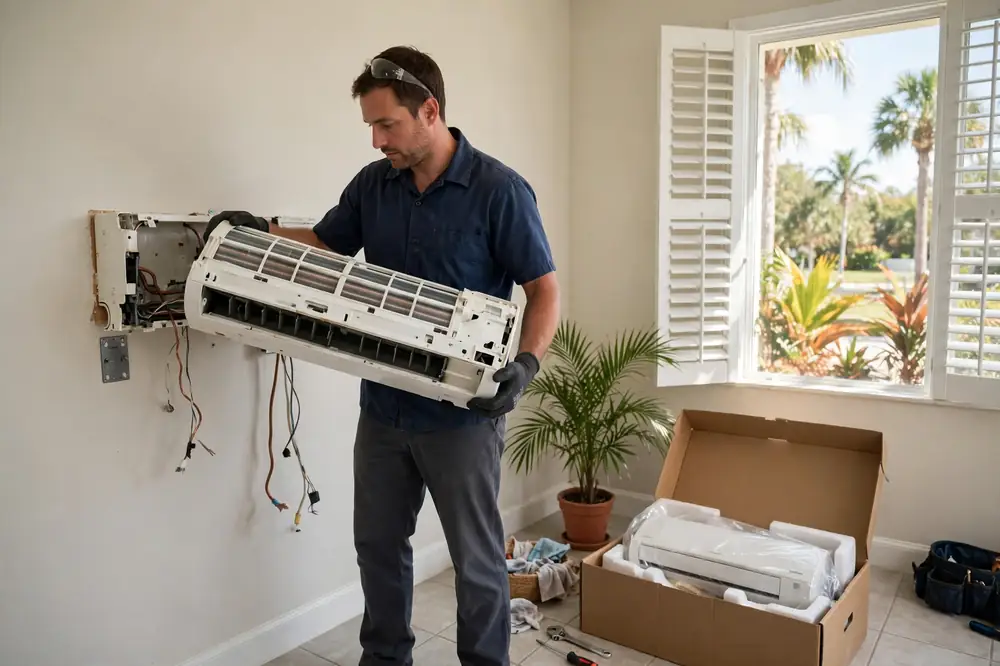
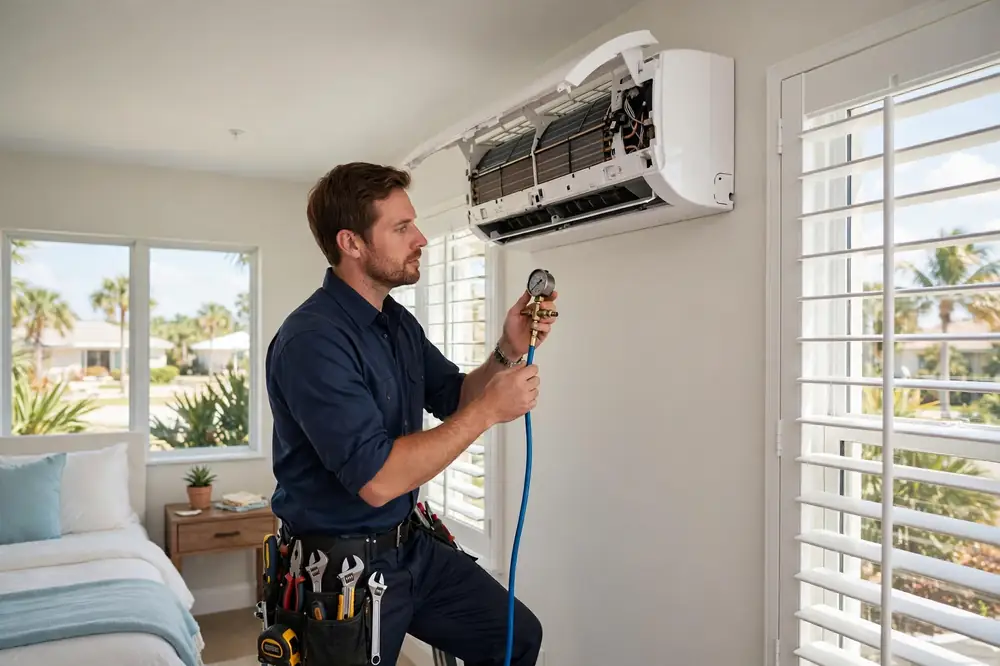
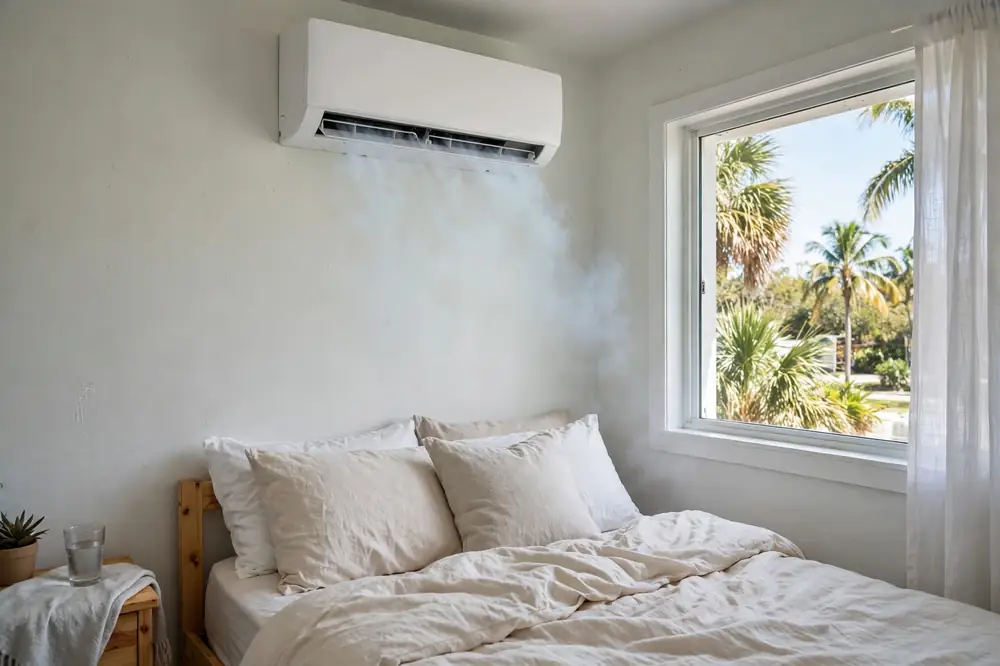
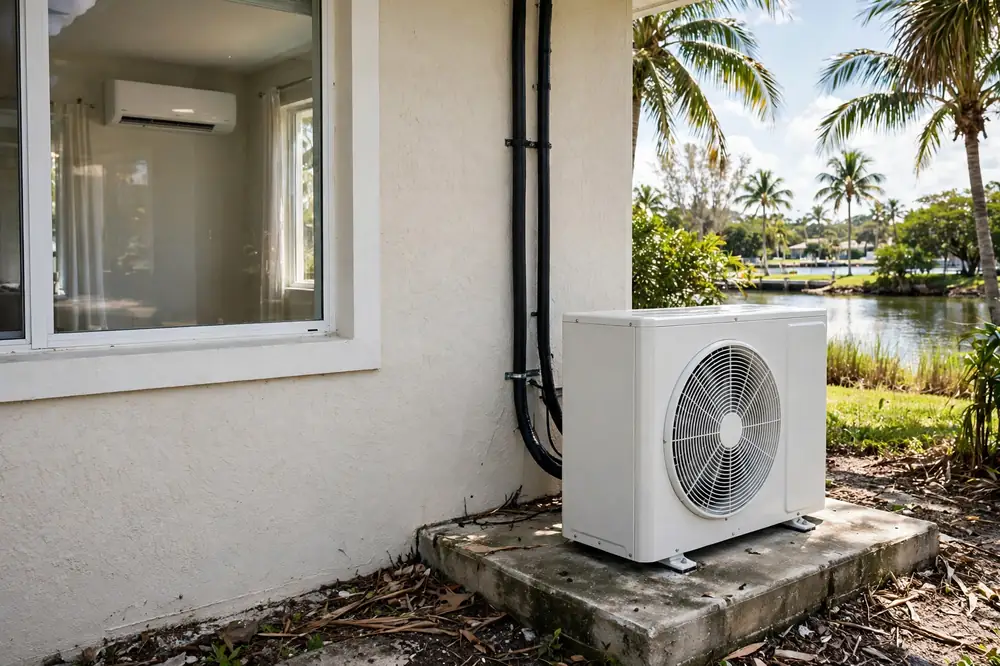
A ductless unit in a Cape Coral home that has not been serviced in two years: a clogged filter, a coated indoor coil, a slow drain, and an outdoor coil crusted with salt.
A room that stays warm, damp or noisy does not fix itself — and the cause is usually small: a dirty filter, a clogged drain, or a unit sized wrong for the room.
A cleaned filter and coil, a flushed drain, a rinsed outdoor unit, pressures checked against the last visit, and a unit that cools and dehumidifies the way it did when it was new.
The work is checked in the room, at the thermostat and at the outdoor unit — not guessed from the driveway.
Guides and posts that go with mini split maintenance
Signs your mini split is due for maintenance
- Cooling that has weakened since last summer, even though nothing has broken.
- A filter that has not been cleaned in months — or a filter the owner has never removed.
- A musty smell when the unit starts, which fades after a few minutes.
- Water on the floor under the indoor unit, even once.
- White crust on the outdoor coil fins, or fins that feel rough and crumbly.
- A unit that runs longer than it used to, to hold the same temperature.
- A remote that has lost a mode, or a unit that no longer dehumidifies in Dry mode.
- A year or more since the last visit, in a home that runs the unit most of the year.



Related guides
Salt-air corrosion · Why your mini split smells · Mini split humidity guide
Industries that use this service
Residential · Property Management · Hospitality & Restaurants · All industries →
Frequently asked questions
Questions people ask about mini split maintenance, answered plainly.
Once a year at minimum, and twice a year for a unit that runs most of the year or sits near salt water. The filter is the owner job between visits — it comes out, rinses and goes back in, more often in a home with pets or dust. The visit covers the coil, the drain, the outdoor unit, the pressures and the electrical, which the owner cannot reach.
Open the front panel of the indoor unit, slide the filter out, rinse it under a tap, let it dry completely, and slide it back in. The handover after an install or a maintenance visit shows how it comes out on your unit. Never run the unit without the filter, and never put a wet filter back in.
The outdoor coil is inspected for the early signs — white crust on the fins, fins that crumble when touched, refrigerant stains at the coil — and rinsed to wash salt off the fins. The cabinet and fasteners are checked for corrosion. Rinsing and inspection do not stop corrosion, but they catch it early, while the coil can still be protected rather than replaced.
Algae and biofilm grow in the warm, dark, wet drain line and clog it. The line is flushed on a maintenance visit, and the fall is checked so water runs downhill away from the house. A drain that keeps clogging between visits may have too little fall, a sag in the line, or a pump that is failing. The leaking-water post on this site explains the full picture.
Yes. A clean indoor coil and a clean filter are what let the unit dehumidify: the coil needs clean fins to pull moisture out of the air, and the filter needs clear airflow to move that air across the coil. A dirty coil and a clogged filter are the most common reason a unit cools but leaves the room clammy. The humidity guide on this site explains the dehumidification picture.
The coil for salt-air corrosion, the cabinet and fasteners for corrosion, the fan for wear, the anchoring for wind damage, and the refrigerant pressures while the unit runs. The coil is rinsed to wash salt off the fins. The outdoor unit is the part of the system that lives in the weather, and in Cape Coral, FL that weather is salt air and hurricanes.
Yes — a unit that is cooling fine is the unit that maintenance keeps fine. The visit catches the slow changes: a coil starting to corrode, a drain starting to slow, a pressure reading that has drifted since the last visit. Those are the faults that become repairs if they are left, and they are cheaper to catch than to fix.
Mini split trouble in your Cape Coral home?
Call Now to reach a local mini split professional. Describe the room, the system, and what is happening.
Call now for mini split help
Tap Call Now to reach a local mini split professional. Tell them which room, what the unit is doing, and when it started.
Hours: Mon–Fri 7:00 AM–10:00 PM ET · Sat 8:00 AM–10:00 PM ET · Sun 7:00 AM–9:00 PM ET
Before you call
- Note which room the unit serves and what it is doing — or not doing.
- Check the remote: mode, temperature setting, and whether the display responds.
- Look at the indoor filter and the outdoor unit for leaves, dirt or standing water.
- Note when the problem started and whether it followed a storm or a power outage.
- Check whether your HOA or condo association needs to approve outdoor equipment.