Mini Split Not Cooling in Cape Coral, FL
A mini split that will not cool in Cape Coral, FL is usually telling the truth about a short list of faults. This post walks through the causes in the order they are checked — mode, filter, coil, drain, then refrigerant.
Cape Coral Mini Split Pros · 2026-11-18 · Troubleshooting
The short version
Problem: Check the mode first: Fan does not cool, and Dry cools weakly by design.
What to do: A dirty filter or indoor coil is the most common cause of weak cooling.
When to call: Low refrigerant means a leak — the leak is found before any refrigerant is added.
Start with the mode
The first check is the mode on the remote, because it is the fault that looks like a breakdown and is not one. A unit set to Fan does not cool — it runs the indoor fan without cooling or heating, for air movement alone. A unit set to Dry cools weakly by design: Dry mode runs the coil cold and the fan slow to dehumidify, and the room feels cooler without getting much colder. A unit set to Auto may be heating when the room needs cooling, if the set temperature is above the room temperature.
The remote batteries are the second check, because a remote with flat batteries does not send the signal at all, and the unit stays in the mode it was last in. The set temperature is the third: a unit set to a temperature above the room temperature will not cool, because it has nothing to do. The mode, the batteries and the set temperature are the three checks that take a minute and explain a surprising number of not-cooling calls.
The filter and the indoor coil
A dirty filter or a dirty indoor coil is the most common cause of weak cooling in a Florida home. The filter sits behind the front panel of the indoor unit, and it collects the dust that the air carries — more in a home with pets, more in a home with a lanai door that stays open, more in a unit that runs most of the year. A filter that has not been cleaned in months chokes the airflow, and low airflow is the fault that looks like everything else: weak cooling, icing on the coil, a unit that short-cycles.
The indoor coil sits behind the filter, and it collects the dust and growth that the filter lets through, especially in a humid home. A coated coil does not transfer heat well, so the cooling weakens and the unit runs longer. The filter comes out, rinses under a tap, dries completely, and goes back in. The coil is cleaned with a coil cleaner that does not bend the fins. The maintenance page on this site explains the filter and coil routine in full.
The outdoor unit in salt air
The outdoor unit is the part that lives in the weather, and in Cape Coral, FL that weather is salt air. The outdoor coil corrodes in salt air — first as a white crust on the fins, then as pitting, then as fins that crumble when touched — and a corroded coil does not transfer heat well, so the cooling weakens. Florida HVAC sources put unprotected coil life at 3 to 7 years within 10 to 15 miles of salt water, and a Cape Coral, FL home near the Gulf or on a saltwater canal is inside that range.
The outdoor fan is the second check. A fan that is worn, or a fan that is blocked by debris, does not move air across the outdoor coil, and the heat has nowhere to go. The clearance around the unit matters too: a unit with no clearance on one side cannot breathe, and a unit that cannot breathe cannot cool. The coil is rinsed on the maintenance visit, the fan is checked for wear, and the anchoring is checked for wind damage.
The drain and the ice
Ice on the indoor coil is the sign that the unit is running with a fault, and the fault is usually low refrigerant or low airflow. A unit that is icing up is usually low on refrigerant or starved of airflow, and both faults get worse with running. Switch it off. Water on the floor under the indoor unit is the other sign: a blocked drain line, a cracked drain pan, or an indoor unit that is not level. Algae and biofilm grow in the warm, dark, wet drain line and clog it, so condensate backs up into the indoor unit.
The drain is flushed, the pan is checked for level and for cracks, and the fall of the line is checked so water runs downhill away from the house. The ice is the warning: a unit that is icing up and keeps running will damage the compressor, and a compressor is the most expensive part of the system. The leaking-water post on this site explains the drain picture in full.
The refrigerant circuit
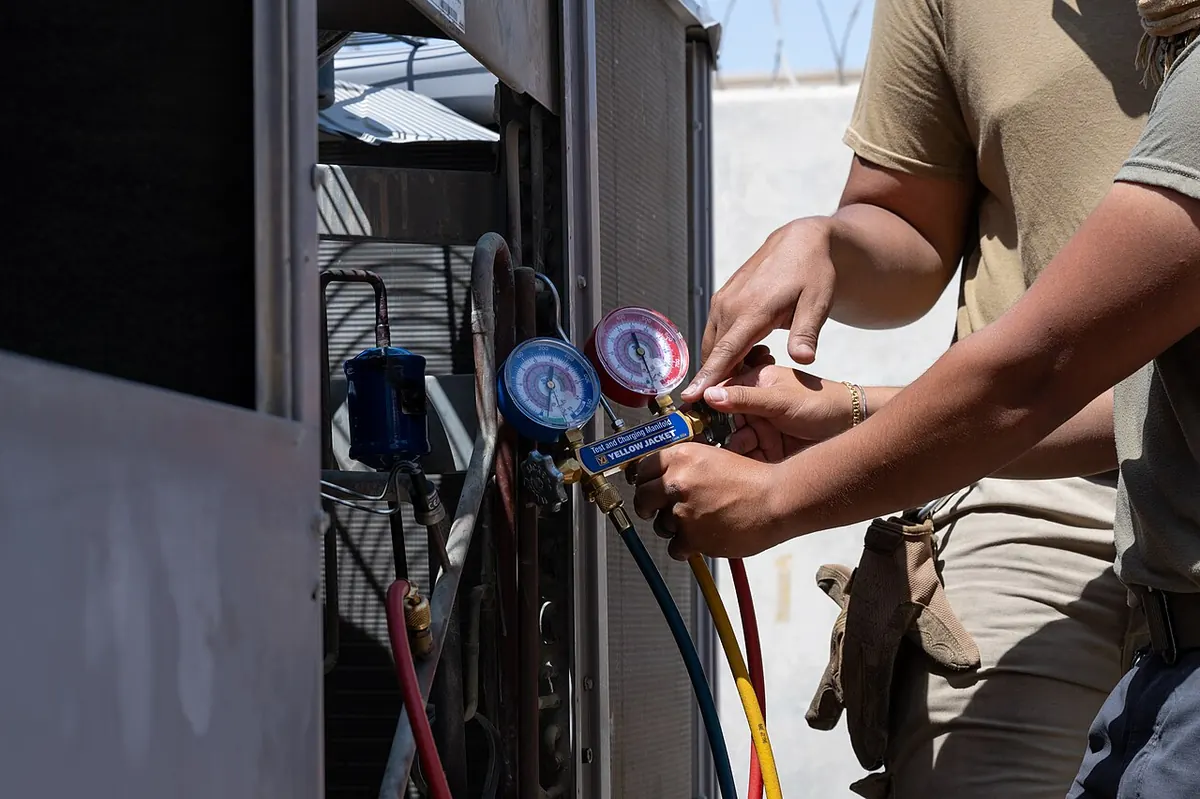
The refrigerant circuit is checked last, because it is the most expensive fault to misread. Pressures and temperatures are read while the unit runs, and they are compared with what the system should show. Low pressure with a warm coil points to low refrigerant; low pressure with a cold, icing coil points to airflow. If the refrigerant is low, the leak is found — at a flare joint, at the coil, or at a valve — before any refrigerant is added, because a recharge without a leak repair is a temporary fix.
A leak at a corroded outdoor coil in a salt-air location is the fault that most often turns a repair into a replacement. A leak at a flare joint or a valve can usually be repaired: the joint is remade, the system is pressure-tested, vacuumed and recharged. The repair page on this site explains the diagnosis order, and the replacement page explains how the repair-or-replace decision is made.
When it is not a fault
Some not-cooling calls are not a fault at all, and the diagnosis is the moment that is found. A room that gained a glass door, lost a shade tree, or changed from a bedroom to a home office carries a different load than it did, and a unit sized to the old room may no longer fit the new one. A lanai with glass on three sides that was sized as a bedroom will run all day and never catch up on a hot afternoon — and the fault is the sizing, not the system.
A unit that is undersized for the room is a unit that runs all day and never reaches the set temperature, and the answer is a replacement sized to the room as it is now, by a fresh load check. The sizing guide on this site explains the load check in full, and the replacement page explains the decision. The assessment is the moment the sizing is checked, and it happens before any part is replaced.
The maintenance visit that prevents the call
Most not-cooling calls are preventable, and the maintenance visit is the prevention. The visit covers the filter, the indoor coil, the drain, the outdoor coil and cabinet, the fan, the refrigerant pressures, the electrical connections, and the remote and the modes. The visit is also the moment a slow change is caught — a coil starting to corrode, a drain starting to slow, a pressure reading that has drifted since the last visit, a fan starting to wear. Those are the faults that become repairs if they are left, and they are cheaper to catch than to fix.
The filter is the owner job between visits: it comes out from behind the front panel, rinses under a tap, dries completely, and goes back in — every few weeks in a Florida home. A filter that is cleaned every few weeks keeps the coil clean, the drain clear and the unit running the way it did when it was new. A maintenance visit that finds nothing wrong is not a wasted visit — it is the visit that kept the next repair from happening. The maintenance page on this site explains the routine in full.
Related: Mini split repair · Mini split sizing guide · mini split help in Cape Coral, FL
Related reading
 Troubleshooting
Mini Split Leaking Water in Cape Coral, FL
Water on the floor under a mini split in Cape Coral, FL is usually a blocked drain — algae and biofilm in the warm, dark, wet line. This post explains the drain, the pan, the level, and why water outside the house is normal and water inside is not.
 Troubleshooting
Why Your Mini Split Smells
A mini split that smells musty, sour or chemical when it starts is telling the truth about a specific fault. This post explains what each smell means — the coil, the drain, or the refrigerant — and what fixes it.
 Troubleshooting
Mini Split Making Noise
A mini split that makes a noise it never made before — grinding, rattling, clicking or buzzing — is telling the truth about a specific fault. This post explains what each sound means and what fixes it.
Frequently asked questions
Questions people ask about this topic, answered plainly.
The most common causes are a dirty filter or indoor coil, a unit set to the wrong mode, low refrigerant from a leak, or a failed sensor or capacitor. The diagnosis checks power and control first, then airflow, then the drain, then the refrigerant circuit — in that order. This post walks through each cause.
Check the mode first: Fan does not cool, and Dry cools weakly by design. Then the filter and the indoor coil — a dirty filter chokes the airflow, and low airflow looks like a failed compressor. Then the outdoor unit: a corroded coil or a worn fan. The refrigerant circuit is checked last, because it is the most expensive fault to misread.
Ice on the indoor coil means the unit is running with a fault: low refrigerant, or low airflow from a dirty filter or a dirty coil. Switch it off — a unit that is icing up and keeps running will damage the compressor. The repair page on this site explains the diagnosis order.
Yes. Low refrigerant means a leak, and the leak is found before any refrigerant is added — at a flare joint, at the coil, or at a valve. A recharge without a leak repair is a temporary fix: the unit will be low on refrigerant again within weeks. A leak at a corroded outdoor coil is the fault that most often turns a repair into a replacement.
Because the load is bigger in the afternoon. The sun is on the windows and the roof, the outdoor temperature is at its highest, and a unit that is undersized or a coil that is dirty cannot keep up. A room that gained a glass door or lost a shade tree carries a different load than it did. The sizing guide explains the load check.
No, if it is icing up or leaking water. Switch it off. Ice on the coil means the unit is running with a fault that will damage the compressor if it keeps going, and water on the floor rots drywall and flooring. A unit that is weak but not icing and not leaking can run while the call is arranged — and the call is arranged promptly.
When the room changed — a glass door added, a shade tree lost, a bedroom turned office — or when the unit was sized by guesswork in the first place. A unit that runs all day and never reaches the set temperature on a hot afternoon, with clean filters and no error code, is a unit that may be undersized. The assessment checks the sizing before any part is replaced.
Still have questions?
Call Now to reach a local mini split professional — describe the room, the system, and what is happening.
Call now for mini split help
Tap Call Now to reach a local mini split professional. Tell them which room, what the unit is doing, and when it started.
Hours: Mon–Fri 7:00 AM–10:00 PM ET · Sat 8:00 AM–10:00 PM ET · Sun 7:00 AM–9:00 PM ET
Before you call
- Note which room the unit serves and what it is doing — or not doing.
- Check the remote: mode, temperature setting, and whether the display responds.
- Look at the indoor filter and the outdoor unit for leaves, dirt or standing water.
- Note when the problem started and whether it followed a storm or a power outage.
- Check whether your HOA or condo association needs to approve outdoor equipment.